Grodziskie: Everything you need to know about ‘Polish Champagne’
How did a beer that was exported to 37 countries 100 years ago become extinct, then get revived from the dead? The story of Grodziskie is delightfully dramatic, a segment of little-known beer history with twists and turns aplenty.
From the power of prayer to the power of the Third Reich, Grodziskie has a fascinating past matched only by its unusual and enticing flavour. A historic beer style whose documented history dates back to the early 17th century, but is likely much older, Grodziskie is making a comeback, both in its native Poland and in the US, where it is growing in popularity as part of a wave of interest in classic European beer styles, including Lichtenhainer and Roggenbier. In this article you’ll learn about how Grodziskie is made, its long and colourful history, what to expect when you taste it, who is reviving it and where you can find it now.

- So, what is Grodziskie?
- Something in the water
- A high value item
- Decline and fall
- Cross-continental curiosity
- Dodging the Nazis
- Collaborative love
- Modern times
-
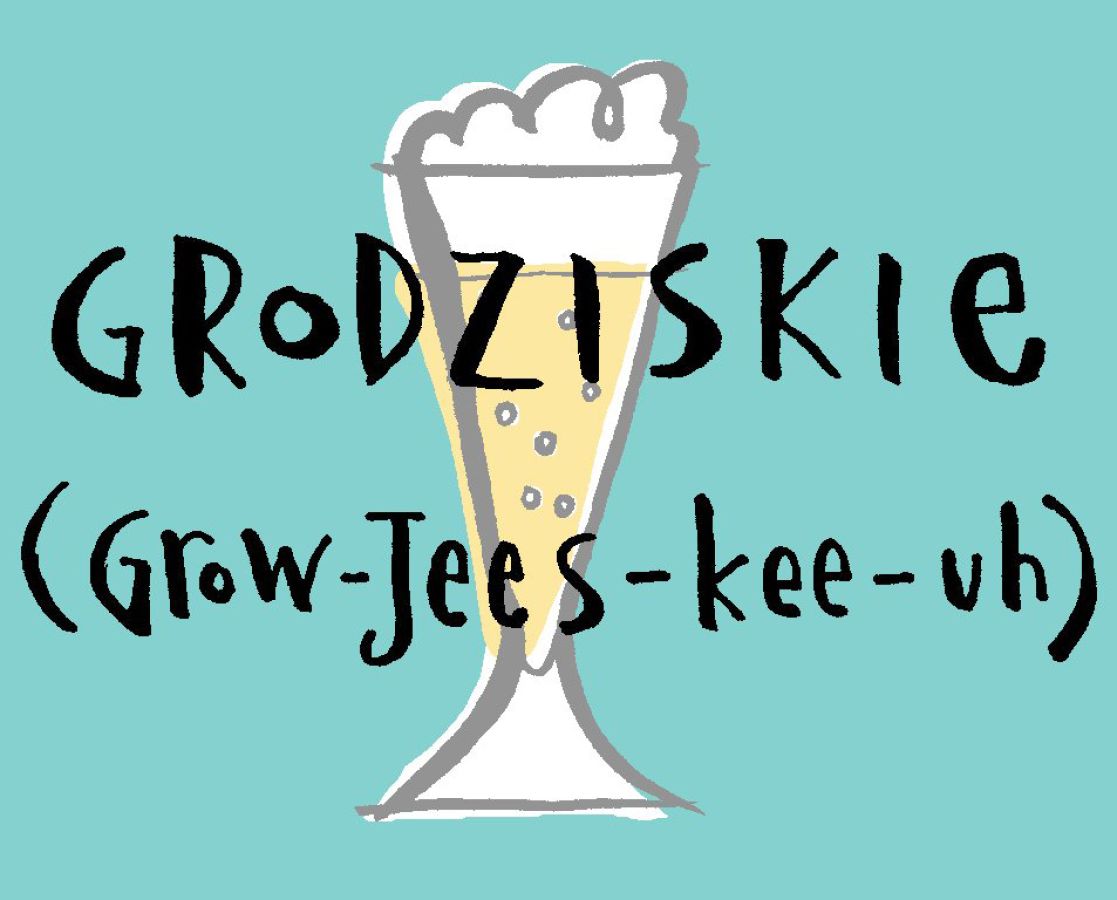
So, what is Grodziskie?
Grodziskie is a 100% smoked wheat beer, brewed with Polish noble hops and historically top-fermented, from the town of Grodzisk Wielkopolski in the central west of Poland, close to the German border.
Key characteristics of Grodziskie are its full smoky aroma and flavour, which come from using 100% oak smoked wheat, and its clear light body, which was traditionally fined with isinglass, removing the haze often associated with wheat beers, although modern brewing techniques have negated the need for this step. It has a low ABV – usually less than 4% and can drop to as little as 2%. Grodziskie is highly carbonated – traditionally bottled or kegged before fermentation was complete to give the beer a rich full foamy long-lasting head made of tight white bubbles.
-
Historically, Grodziskie was served in a trumpet shaped or tall conical glass, allowing plenty of space for the head to sit. The style earned its nickname of ‘Polish Champagne’ from its clear crystalline appearance, intense effervescence and bubbling foam, as well as its reputation for quality. While it can be made with any Polish noble hop, Nowotomyski is the hop most closely associated with Grodziskie in its original form, and the primary choice for contemporary brewers recreating it – another prong in the beer’s dramatic history.
Grodziskie was originally made with a combination of two different yeast strains to create the correct level of flocculation, although only one of these has been successfully recaptured to date. Falling outside the major European beer style trends, neither a classic wheat beer or lager, you might expect that Grodziskie was a niche product only drunk by locals. However, Grodziskie’s magic touch of floral hop crispness, bright minerality and warm smoky sweetness ensured that, for a significant amount of time, it was a premium beverage with a wide reach, available in 37 countries at its prime, less than 100 years ago.

-
Join CAMRA for unlimited access Join CAMRA
Something in the water
-
A high value item
-
Decline and fall
-
Cross-continental curiosity
-
-
Dodging the Nazis
-
Collaborative love
-
Modern times
-