Understanding Hop Compounds
Hops, Humulus Lupulus, are one of the most expressive ingredients available to a brewer when crafting a new brew. With hops, you can paint a malty canvas with flavours ranging from earthy spice, to citrusy pine, and even mango and soursop. The key for the brewer, when designing their beer, is to understand where these flavours come from and how to best utilise the hops available to them, and that requires an understanding of the chemistry of hops.
Illustrations by Christine Jopling.
Things you will learn

- Terpenes
- Resin Fraction
- Essential Oil Fraction
- Terpenoids
- Sulphur Compounds
- Conclusions
-
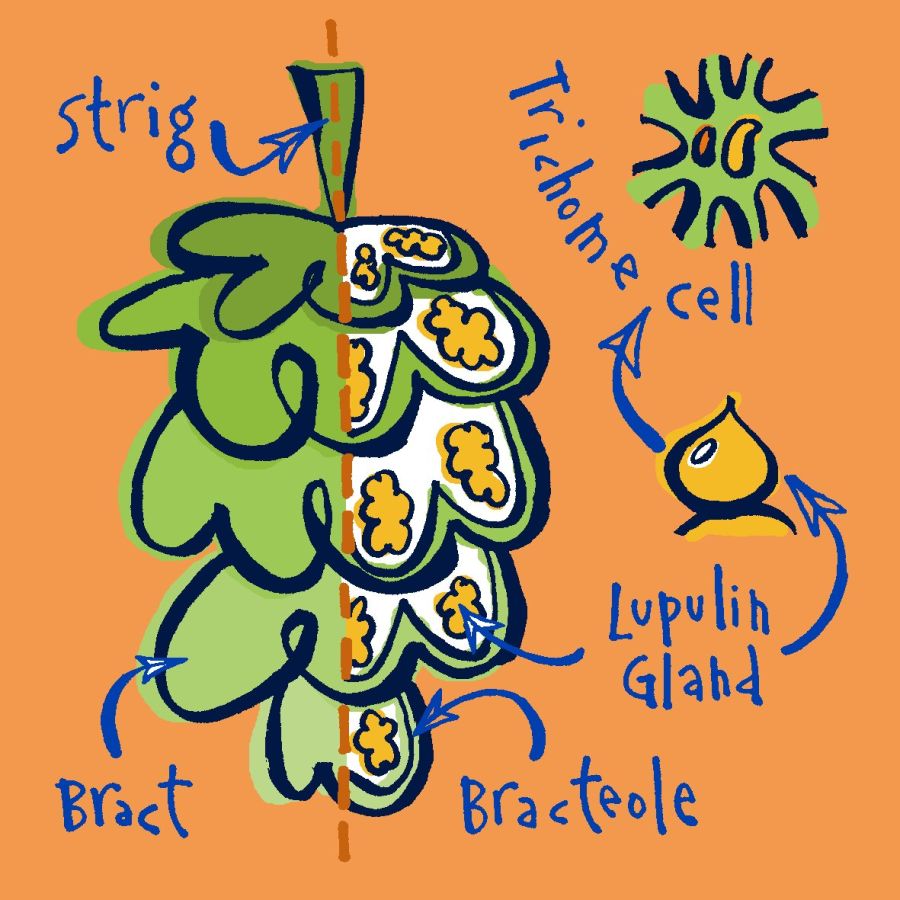
From a brewer’s perspective, one of the valuable parts of the hop flower is found in the Trichome and lupulin glands. This is essentially a sealed box of potential, where the hop plant stores its essential oils, alpha acids, and other compounds; all handily packaged up, as the concentration of compounds would kill the plant if they were stored more generally throughout its growth.
So, we all know that hops make beer taste nice, but what are the compounds in hops that lend them their unique flavour? Over 3000 flavour active compounds have been identified as playing a role in hop flavour and aroma. Many of these exist in such low quantities that, when standing alone, they could not be perceived by the human senses, but in a cascade of aroma, and synergistic amplifying, they help to build a complex sensory experience.
In general terms, hop derived flavour active compounds are separated as coming from the resin or essential oil fraction of the hop cone, and some of the most important compounds are listed below.
-
Join CAMRA for unlimited access Join CAMRA
Terpenes
-
Resin Fraction
-
Essential Oil Fraction
-
Terpenoids
-
Sulphur Compounds
-
Conclusions
“…this is just a snapshot into the thousands of chemicals which go into making a delicious pint of beer, and researchers are constantly discovering newly significant flavours.”